Islington’s Fringe-Central Capital Stack 2026: A Gradient Between Camden And Hackney
Islington is the fringe-central borough sitting between Camden at -6.4% and Hackney at -2.5%, with the borough headline at -4.2% year on year. The geography is the structural read. The borough is a gradient, not a single number. Angel and Upper Street correct at the Camden pace. Highbury and Canonbury hold at the Hackney pace. Holloway is the financeable mid-tier resi-led growth zone with an active BTR forward-fund take-out at 5.0% to 5.25% net. Finsbury and Clerkenwell carry the deepest commercial-to-residential conversion pipeline in inner-north London.
This is the operator-level read on Islington’s full fringe-central capital stack in 2026. Senior development finance from 6.5% on EC1 commercial-to-resi conversion. From 6.75% on Holloway and Highbury mid-rise resi-led. From 7.0% to 7.25% on Angel and Upper Street prime mixed-use. BTR forward-fund take-out at 5.0% to 5.25% on Holloway and the Finsbury fringe. Bridging at 0.55% to 0.75% per month on Canonbury townhouse reposition. Site supply is the bottleneck — Islington is genuinely land-constrained relative to its inner-east neighbours, with very few large consented sites in the pipeline, and the discipline is to know which sub-zone bucket the site falls in before you bid.
Why Islington reads between Camden and Hackney
The 2015 to 2022 cycle was kinder to Islington than to almost any other inner London borough. Angel, Upper Street, Canonbury and Highbury all priced into a deep domestic prime bid that absorbed the gentrification gradient running from Clerkenwell up the Northern Line corridor through to Archway. The 2022 to 2025 correction has been, in turn, less kind. Build costs rose, senior margins widened, and the open-market resi pricing model that underwrote much of the Angel and Upper Street townhouse stock simply stopped clearing on the original basis.
The result by 2026 is a borough where the read is genuinely a gradient, not a single number. Angel and Upper Street are correcting at the Camden pace, with the Highbury and Islington spine sitting exactly on the borough average and the Highbury and Canonbury family-resi belt holding at closer to the Hackney pace. Holloway, the borough’s mid-tier resi-led growth zone, is around the borough number on open-market resi but materially better on the BTR forward-fund take-out. The Finsbury and Clerkenwell south end carries a meaningful commercial-to-residential conversion pipeline that has been fully repriced through the cycle and now clears.
Underwrite Islington as one number and you will misprice the site in either direction. The sub-zone is the appraisal.
Reading the -4.2% in context
Islington’s -4.2% is best read against three reference points.
Against Camden at -6.4%, Islington is materially shallower. Camden carries the Hampstead and Belsize Park super-prime townhouse drag, plus the Bloomsbury prime resilience, plus the King’s Cross life-sciences growth zone. Islington carries a milder version of the same pattern. The Angel and Upper Street prime end is a smaller absolute share of the borough than Hampstead is of Camden, so the prime drag pulls less weight. The borough also lacks a Camden-equivalent institutional growth engine, which means there is no King’s Cross-style structural offset on the financed-GDV side.
Against Hackney at -2.5%, Islington is materially deeper. Hackney’s family-resi spine through Stoke Newington and Hackney Central is a deeper end-user pool at the £1m to £2.5m flat-and-house end than Islington’s equivalent through Highbury and Canonbury, simply because Hackney prices were lower at the start of the cycle. Hackney also has Hackney Wick and Shoreditch as institutional-feeling sub-zones that run on BTR take-out economics rather than open-market resi. Islington has the equivalent at Holloway and Finsbury but at a smaller pipeline scale.
Against Walthamstow at +5.9% and the Greater London headline of -3.3%, Islington is around 0.9 percentage points worse than the regional benchmark and 10.1 percentage points behind the Walthamstow outperformance. The Walthamstow-Islington spread is essentially the Angel and Canonbury townhouse weight that Walthamstow does not carry showing up in the borough average.
So Islington is a fringe-central borough doing a fringe-central job on the borough number. Quietly worse than the regional benchmark, materially better than Camden, materially worse than Hackney. The gradient is real and it tracks the geography directly.
The sub-zone anatomy
Angel and Upper Street (N1 south). Premium domestic prime plus the Upper Street commercial spine. The hardest part of the borough in 2026. The Upper Street townhouse stock, the Angel mansion-block flats and the mixed-use frontage all carry exposure to the same domestic-prime softening that has hit the Camden Hampstead end. This is where the borough’s correction pricing lives. Senior debt on Angel mixed-use sits at 7.0% to 7.25% per annum at 60% to 65% LTGDV, which is the correction-zone band the broader inner-west prime market is also seeing.
Canonbury and Barnsbury (N1). Premium townhouse, deep family-prime concentration, conservation areas. Tight supply of available stock. Closer to the borough average than Angel because the demand pool is more domestic and the stock is genuinely scarce. The largest concentration of value-add reposition deal flow in Islington is here. Bridging-led, short construction window of 9 to 14 months, exit to a HNW domestic end-user pool that has not recovered to 2018 to 2021 depth.
Highbury (N5). Family-resi spine of the borough. Highbury Fields anchor amenity, Highbury and Islington Overground orbital plus Victoria Line interchange, the Emirates Stadium catchment, deep family-prime end-user demand. The most resilient open-market sub-zone in Islington. Closer to Hackney’s Stoke Newington pace than to the Camden Hampstead pace. Senior debt available on the right scheme at competitive terms.
Holloway (N7). Mid-tier resi-led, the borough’s growth zone. Northern Line spine through Caledonian Road, Holloway Road and Tufnell Park. Closer to flat year on year on the right product than the borough average suggests. The most consistently financeable open-market resi product in the borough. BTR forward-fund operators are active here on the right consents, with take-out yields clearing 5.0% to 5.25% net. Mid-rise resi-led origination at 4 to 10 storeys, 60 to 200 homes, brownfield, around the Holloway Road and Caledonian Road nodes is the spine of the borough’s deal flow.
Finsbury and Clerkenwell border (south EC1). Commercial-to-residential conversion stock plus mixed-use. The Crossrail interchange at Farringdon serves the southern fringe directly. Lender pricing here tracks the Holloway and Hackney Central regen-zone band rather than the prime-central correction band, because the take-out on a converted commercial-to-residential product is institutional-feeling: domestic prime sale at the £900 to £1,300 per square foot band, plus an executive rented residential exit. The deepest commercial-to-resi conversion pipeline in the borough.
Archway and Tufnell Park (N19, N7 north). Fringe, more affordable, mid-tier resi-led. Archway is the borough’s quietest sub-zone, with the lowest absolute price points and the deepest end-user demand at the genuinely-affordable end. Tufnell Park sits on the Northern Line and runs more domestic-prime in character. Both sit outside the borough’s prime drag and on the financeable side of the gradient.
King’s Cross fringe (N1C south, shared with Camden). The borough boundary runs through the King’s Cross corridor. Islington’s slice is materially smaller than Camden’s, but the same forward-fund economics apply on the relevant sites. Mixed-use, institutional take-out.
What lenders are pricing on Islington schemes in 2026
Following the Bank of England’s December 2025 cut to 3.75%, the all-in capital stack on a typical Islington scheme is mid-band, exactly as the borough number suggests. The lender pool is pricing a gradient inside the borough, with the prime end carrying a 25 to 50 basis point premium on margin and a 5 percentage point cap on LTGDV relative to the resi-led mid-tier.
Senior development finance on a Holloway or Highbury mid-rise resi-led scheme is available from 6.75% per annum at 65% to 70% LTGDV for an experienced developer with strong cost certainty. The same lender pool, on an Angel or Upper Street prime mixed-use scheme, is pricing at 7.0% to 7.25% per annum at 60% to 65% LTGDV. On a Finsbury or Clerkenwell commercial-to-residential conversion with a strong sponsor, senior pricing tightens to 6.5% per annum at 70% LTGDV because the take-out comparables are institutional-feeling and the construction window is shorter than ground-up new-build. Stretched senior products are available with strong cost certainty at 7.5% per annum and 75% LTGDV.
Mezzanine finance appetite is thinner on the Angel and Canonbury premium end than on the Holloway and Highbury mid-tier. Where mezz prices on a prime Islington scheme it sits at 12% to 13% per annum, with the JV equity providers demanding 22% to 25% IRR targets. On the mid-tier resi-led Holloway product the mezz pool widens, prices at 12% per annum, and JV IRR thresholds drop to 18% to 22%.
The structurally active layer in Islington is BTR forward funding on Holloway and Finsbury fringe consents. Institutional take-outs are clearing 5.0% to 5.25% net yields. That is a touch tighter than Hackney Wick at 5.0% to 5.5% and meaningfully tighter than the open-market resi alternative. For a Holloway site that does not clear viability on a pure open-market resi appraisal, the BTR forward-fund take-out at 5.1% net yield can rescue the residual.
Bridging is active across the borough, particularly on Canonbury and Barnsbury townhouse reposition windows and Clerkenwell value-add opportunities. Pricing 0.55% to 0.75% per month, with the wider end on the premium townhouse exit where the buyer pool is thinner.
The Holloway mid-rise resi-led growth zone
Holloway is the structural story that the borough average understates. The Northern Line spine through Holloway Road and Caledonian Road carries some of the most consistently financeable mid-rise resi-led origination in inner London in 2026. The reasons are practical. The land is brownfield-led, the consents are achievable under the post-NPPF Time-Limited Planning Route at 20% affordable housing by habitable room, the open-market resi take-out is supported by the same Highbury family-prime depth one node south, and the BTR forward-fund operators are actively bidding on the larger consents.
A 4 to 10 storey, 60 to 200 home Holloway scheme around the Holloway Road or Caledonian Road nodes can be financed through senior at 6.75% per annum and 65% to 70% LTGDV with a credible BTR forward-fund take-out at 5.0% to 5.25% net yield. That structure compresses the senior margin by 10 to 25 basis points relative to a pure open-market resi take-out, because the institutional commitment de-risks the back end of the appraisal. On a Holloway consent that supports both an open-market resi and a BTR exit, the lender pool is materially competitive and the equity IRR threshold drops to 18% to 22%.
This is the financeable corner of Islington in 2026. The borough’s land-supply constraint is a real bottleneck, but the schemes that clear are clearing on competitive terms.
The Clerkenwell and Finsbury commercial-to-residential conversion play
The southern fringe of Islington, where the borough boundary meets the City through Finsbury and Clerkenwell, carries the deepest commercial-to-residential conversion pipeline in inner-north London. The post-NPPF planning regime has widened the routes through which underused commercial product can be repurposed to residential, and the EC1 fringe is where that opportunity sits hardest in Islington. Office stock built into a different yield environment, repriced through the 2022 to 2025 correction, now clears on a conversion appraisal at credible Crossrail-anchored take-out comparables.
The take-out is a blend of domestic prime sale at £900 to £1,300 per square foot and an institutional executive rented residential exit. The capital stack runs senior at 6.5% per annum and 70% LTGDV with a meaningfully shorter equity stack than ground-up new-build, because the construction window compresses to 12 to 18 months on a conversion product with the structural shell already in place. For a Finsbury or Clerkenwell sponsor with a credible conversion track record, this is one of the most-financeable corners of the inner-east London map in 2026.
What is actually transacting in Islington
Four categories of activity dominate Islington deal flow in 2026.
1. Holloway mid-rise resi-led, the spine of the borough. 4 to 10 storeys, 60 to 200 homes, brownfield, around the Holloway Road and Caledonian Road tube nodes. Open-market resi sales model with a BTR forward-fund alternative on the larger consents. The most consistently financeable open-market resi product in the borough.
2. Finsbury and Clerkenwell commercial-to-residential conversion, the EC1 fringe. Existing office product repurposed to residential under post-NPPF planning routes. Domestic prime sale plus executive rented residential take-out. Senior at 6.5% per annum, shorter window, lower equity threshold than ground-up.
3. Canonbury, Barnsbury and Highbury value-add reposition on townhouse stock. Bridging-led, short construction window of 9 to 14 months, exit to a HNW domestic end-user pool. The largest concentration of bridging deal flow in Islington by value.
4. Angel and Upper Street prime mixed-use, the borough’s most rate-sensitive sub-zone. Smaller pipeline than the previous three, with senior pricing in the correction-zone band at 7.0% to 7.25% per annum and meaningfully thinner mezz pool. Equity thresholds 35%-plus of cost reflect the exit-pool risk premium.
What is much smaller in 2026: large-site ground-up new-build resi-led origination across the borough. Islington is land-constrained relative to almost every other inner-east borough, with very few large consented sites in the pipeline. The borough’s 2026 deal flow is dominated by mid-cap consents and conversion product rather than master-planned new-build.
How the capital stack works on a £20-30m GDV Islington scheme
A typical Holloway or Highbury mid-rise resi-led scheme at this scale, with strong PTAL within a 10-minute walk of a Northern Line node, can be financed with senior development finance at 65% to 70% LTGDV (around 6.75% per annum), mezzanine layered to 90% of cost (12% per annum), and a modest equity or JV equity component to close the gap. Total senior plus mezz cost-of-funds blends in the high sevens, with the JV equity targeting 18% to 22% IRR over the construction-and-absorption window.
On a Holloway scheme of similar scale with a credible BTR forward-fund take-out at 5.0% to 5.25% net yield, the structure tightens. The institutional forward-fund commitment de-risks the take-out, which compresses the senior margin by 10 to 25 basis points and reduces the mezzanine stretch required. Blended cost-of-funds drops into the mid-to-high sixes, and the equity gap closes against a contractually-committed exit. This is the financeable corner.
On a Finsbury or Clerkenwell commercial-to-residential conversion at the £20m to £30m GDV end, the structure runs senior at 6.5% per annum and 70% LTGDV, with a shorter construction window of 12 to 18 months and a domestic-prime-plus-executive-rental take-out. The equity demand drops to 25% to 30% of cost reflecting the shorter window and the institutional-feeling exit.
On a Canonbury or Highbury value-add reposition at the £8m to £15m GDV end, the structure tightens further to bridging plus refurb plus equity. Bridging in this band sits at 0.65% to 0.75% per month, with the equity demand 30% to 35% of cost reflecting the HNW exit-pool risk premium.
Islington supports smaller average consents than Hackney or Tower Hamlets, and materially smaller than the King’s Cross corridor in Camden. The borough’s £40m+ scheme pipeline is thin, with most of the borough’s deal flow at the £15m to £30m GDV mid-cap end.
What this means for site acquisition
If you are pricing an Islington site in 2026, three things matter more than they have in any recent cycle.
One. The sub-zone is the appraisal. An Angel site, a Canonbury site, a Holloway site and a Finsbury commercial-to-resi site are four different propositions with four different capital structures and four different take-out models. The borough average tells you almost nothing useful about any individual site. Get the sub-zone, the postcode, the take-out structure and the buyer profile on the first page of the IM.
Two. Site supply is the bottleneck. Islington is genuinely land-constrained relative to its inner-east neighbours, with very few large consented sites in the pipeline. The financeable corner of the borough is mid-cap consents in Holloway and Highbury, plus commercial-to-resi conversion stock in Finsbury and Clerkenwell, plus value-add reposition on Canonbury and Barnsbury townhouse. Anything outside those four buckets is materially harder to clear. The discipline is to know which bucket the site falls in before you bid.
Three. The BTR forward-fund take-out is now a real lever in Holloway and the Finsbury fringe. A site that does not clear the open-market resi test on its own can clear a 5.1% net yield BTR take-out. That is a structural opportunity, but it requires the right scheme architecture, credible rental tone, and an institutional partner. It is not a default outcome. Where it does work, the senior margin compresses 10 to 25 basis points and the equity threshold drops materially.
For full borough-by-borough sold price data, the Islington sub-zone pipeline references, viability modelling and the underlying capital stack benchmarks behind this analysis, see the Greater London Property Market Report 2026. Borough-specific intelligence sits on the Islington location page, with dedicated pages for Highbury, Holloway, Angel and Clerkenwell underneath.
See also: Walthamstow +5.9% on YouTube and The £650/sq ft Cliff on YouTube.
Listen to the full episode
For the dedicated deep dive on this borough, we have published a stand-alone Islington episode of the Construction Capital podcast: Islington -4.2%: Highbury Resilience, Holloway Growth, Clerkenwell Conversion and the Angel Drag. Around ten minutes covering the fringe-central read on the borough, the Holloway BTR forward-fund take-out, the Clerkenwell and Finsbury commercial-to-resi conversion play, the Canonbury and Highbury value-add reposition window, the Angel and Upper Street correction-zone pricing, and what is actually transacting across the borough in 2026.
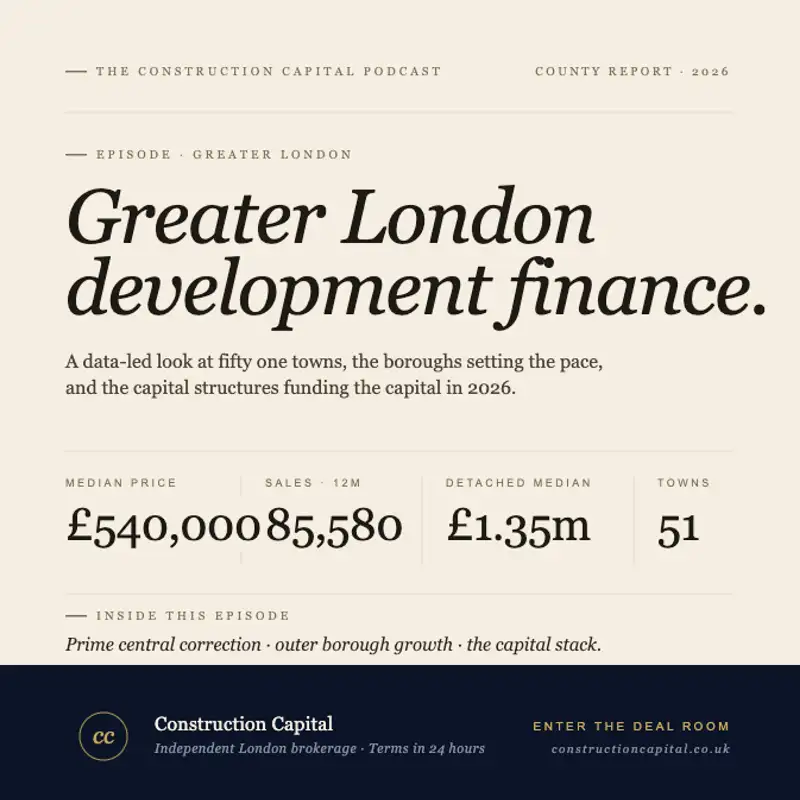
This article also draws on Episode 2 of the Construction Capital podcast: Greater London Property Development Finance 2026: Market Analysis, House Prices and Lending Outlook.
Listen anywhere
Listen on Apple Podcasts, Spotify, Overcast, Pocket Casts, or Amazon Music.
For indicative terms on an Islington scheme within 24 hours, submit through the Construction Capital deal room. Construction Capital sources terms from over 100 lenders across development finance, bridging, mezzanine and equity.
Published by Construction Capital, an independent capital advisory brokerage sourcing terms from over 100 lenders across development finance, bridging, mezzanine, and equity. This article is part of the Greater London 2026 series accompanying the Construction Capital podcast.